LEDDA
KNUDSON
Work
About
Resume
Contact
Reach out to connect or collaborate
Leddaknudson@gmail.com
From Concept to Reality
Throughout the project, concepts were reviewed through sponsor presentations, stakeholder discussions, CPM reviews, and live demonstrations.
Feedback consistently reinforced the value of contextual alerts, maintenance coordination, installation workflows, and location visibility, validating the shift from sensor monitoring to real-world incident response.
Collaborating with teams across New York and Finland reinforced the importance of aligning technical innovation, user needs, and operational realities to create solutions that work beyond a single context or environment.


Ecosystem validation of the sensor-to-platform experience.
Product Development Gala presented in Espoo, Finland (May 2026).
NYC Team Presenting at the Design Factory Gala
Making Invisible Leaks Visible
Designing a connected ecosystem for battery-free leak detection.
Designing Beyond the Sensor
The final solution combined sensors, receivers, cloud infrastructure, installation workflows, and property management tools into a connected experience.
Together, these components supported the complete lifecycle of leak response, from detection and investigation to maintenance coordination and resolution.
The final product unified monitoring, investigation, property management, and installation workflows into a connected ecosystem. By organizing information around user tasks instead of sensor data alone, the experience helped teams move from awareness to action with greater speed, clarity, and control.


See full Prototype
Learning an Industry from the Ground Up
Before designing solutions, we needed to understand how leak events move through a building.
Through interviews with sponsors, installers, and property managers, we mapped the process from detection and notification to investigation, maintenance coordination, and resolution.
This research revealed that leak response is not a single action but a sequence of decisions involving multiple handoffs, responsibilities, and operational constraints.
Stakeholder Ecosystem Map
The service blueprint exposed communication gaps between stakeholders, helping us prioritize workflows that reduced investigation friction.






...
Main Lobby Sensor
Check Details
X
Sensor #9857273 • Floor 1
Boiler Room Sensor 1
Check Details
X
Sensor #9882273 • Floor 2
Boiler Room Sensor 2
Check Details
X
Sensor #9882553 • Floor 5
Basement Sensor
Check Details
X
Sensor History
Check Details
X
Sensor #9841273 • Floor -1
All Sensor history

0 Active Alerts
2228 JFK Blvd
View Property Info

View Property Info
Floor Map: 3233 Park Place
PrinSys is a Finnish startup developing battery-free water leak detection technology designed to protect buildings for more than a decade without maintenance, wiring, or battery replacements.
Through a collaboration with Aalto University and Pace University, our team explored how this emerging technology could evolve into a scalable product experience for commercial property operations.
Together, we transformed battery-free leak detection technology into a connected ecosystem spanning sensors, cloud infrastructure, maintenance workflows, and mobile experiences.
As the lead UX designer for the U.S. team, I designed the alert management and maintenance experience, helping property managers detect, investigate, and respond to leak events.
Seeing the Bigger System
Mapping these relationships helped identify opportunities to improve visibility, coordination, and accountability across the service ecosystem.
As our understanding evolved, it became clear that successful leak response depended on a network of interconnected stakeholders.
Property managers, maintenance teams, installers, residents, sensors, receivers, and cloud systems all played a role in how information moved through the experience.

Defining Success Criteria
• Improved visibility into incident status and resolution
These criteria became the framework used to guide product decisions throughout the project.
To evaluate whether the experience addressed the operational challenges uncovered during research, we established four success criteria:
• Faster identification of active leak events
• Reduced effort locating affected sensors
• Clearer prioritization of maintenance actions
Designed a mobile workflow that reduced the number of steps required to investigate and resolve a leak incident.
First View of the App

Where Things Started Breaking Down
As we mapped existing workflows, recurring friction points emerged.
Teams struggled to determine the severity of alerts.
Information moved across disconnected communication channels.
Response times often depended on who happened to notice the problem first.
Stakeholder Ecosystem Map
The concept explored how technical sensor signals could be translated into operational decisions across multiple stakeholder groups.

Integrated Hardware & Software Solution
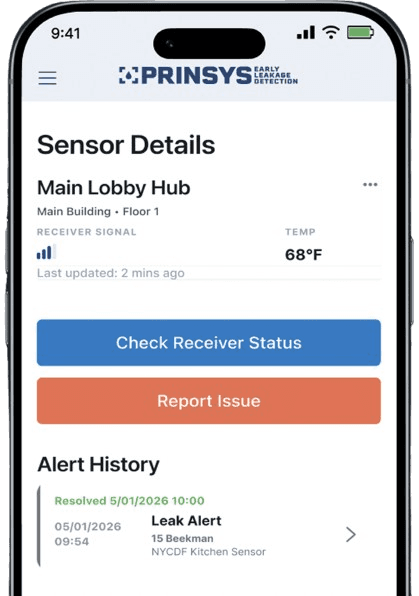
Actionable Alert System


Turning Data Into Decisions
Raw sensor activity provides little value without context. Users needed to understand what happened, where it happened, how urgent it was, and what actions should be taken next.
The alert experience transformed technical sensor signals into actionable information by prioritizing severity, location, system status, and response pathways.

Rather than exposing raw sensor data, the dashboard focused on what mattered most:
What happened, how urgent it was, and what action to take next.
PrinSys had already developed a battery-free leak detection system capable of identifying moisture events without ongoing maintenance.
The challenge was what happened next.
A leak alert alone provides little value unless users can assess urgency, locate the source, coordinate response efforts, and track resolution. Understanding how these decisions were made became the foundation for the product experience we set out to design.
The Technology Behind the Challenge

Leak detection was only the first step. Users needed contextual alerts, location visibility, and clear workflows to assess incidents and coordinate response efforts.
Choosing What Not to Build
One of the most significant product decisions involved automated water shut-off functionality.
While some stakeholders viewed automation positively, property managers raised concerns about liability, operational risk, and unintended consequences across larger buildings.
Rather than automating critical decisions, we focused on helping users assess situations quickly and make informed response decisions themselves.